
When Innovation Outpaces Equity: Lessons from the Democratized Diagnostics Panel at HLTH
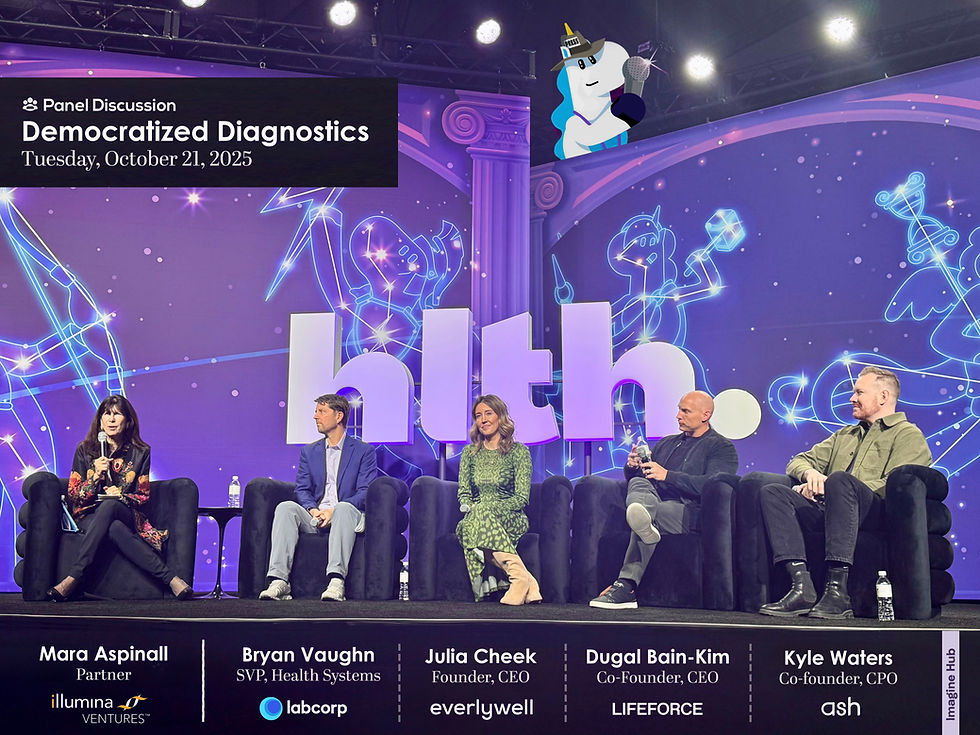
This year's Democratized Diagnostics panel discussion at HLTH Inc. in Las Vegas, NV highlighted how the privatized and decentralized healthcare system in the U.S. that empowers innovation in diagnostics also necessitates it, because it fails, by design, to serve everyone equally or coherently.
Against this backdrop, each innovator on the panel has leveraged the system’s open market to build new paths toward accessibility, using capital, technology, and consumer demand to democratize diagnostics in ways centralized systems would likely have delayed or restricted. Yet each is also, paradoxically, constrained by the same forces that made their success possible. Data silos, inequitable access, an evolving regulatory landscape, and consumer confusion remain endemic to the environment they operate in.
The panelists illustrated these tensions through specific challenges within their respective domains:
Problem: In a competitive healthcare economy, EMR systems and institutions protect their own lab networks, blocking data exchange and forcing patients into duplicative testing when results cannot move freely.
Julia Cheek (Everlywell)
Problem: In a fragmented, payer-driven market, coverage for at-home self-collection tests remains opaque and underutilized. Their emerging status, nonstandard methodologies, and regulatory nuances blur what is billable, leaving patients to pay cash for tests their insurance might have covered.
Problem: In a system built around traditional hierarchies and misaligned incentives, physicians are positioned as gatekeepers rather than advisors, limiting patient choice and collaboration across care teams.
Problem: In an uncoordinated, market-led testing landscape, innovation in self-collection, from new specimen types to shipping variables, has outpaced clinical understanding, widening the knowledge gap between labs and providers and eroding clinical trust in new methodologies.
The key takeaways:
- The U.S. market gives innovators the tools to extend access but offers no shared foundation on which to build enduring equity.
- This problem cannot be solved by any single party or entity. Innovators must work together to advance the democratization of diagnostics and prioritize equal access to affordable care for all.
By engaging one another in an open forum, these leaders acknowledged both the structural complexity of the task and the collective responsibility to align innovation, regulation, and access in pursuit of a more coherent diagnostic ecosystem.
Moderator Mara Aspinall (Illumina Ventures) concluded the panel discussion by pointing to the next horizon: new innovative neurodegenerative diagnostic tests entering the market. They hold extraordinary potential to expand access and reshape early detection, and, like every innovation before them, their potential to help democratize diagnostics will be realized if equity and coherence advance alongside progress.

Comments